DE
 ES
 PT


UK Online Slot Rules Explained: Stake Limits, Spin Speed and Autoplay
Britain limits more than how much a person can bet on an online slot. The regulator, the UK Gambling Commission, also fixes how soon the next spin may start and prohibits several design features found elsewhere. These rules arrived at different times, so each is described here in its current form. For the wider picture see our overview of online gambling regulation in Europe.

UK Online Slot Rules at a Glance
The main requirements in one place:
| Rule | Current requirement |
|---|---|
| Maximum stake, age 18 to 24 | £2 per game cycle |
| Maximum stake, age 25 and over | £5 per game cycle |
| Minimum interval before the next slot game cycle | 2.5 seconds |
| Autoplay | Not permitted |
| Turbo, quick spin, slam stop | Not permitted where they cut the time to the result |
| Simultaneous play of several games | Functionality not permitted |
| Celebrating a return equal to or below the total stake | Not permitted |
The £2 and £5 Online Slot Stake Limits
A player between 18 and 24 may risk up to £2 in each game cycle, while a player from 25 upward may risk up to £5. The £5 cap began on 9 April 2025. The £2 cap for the younger group came later, on 21 May 2025.
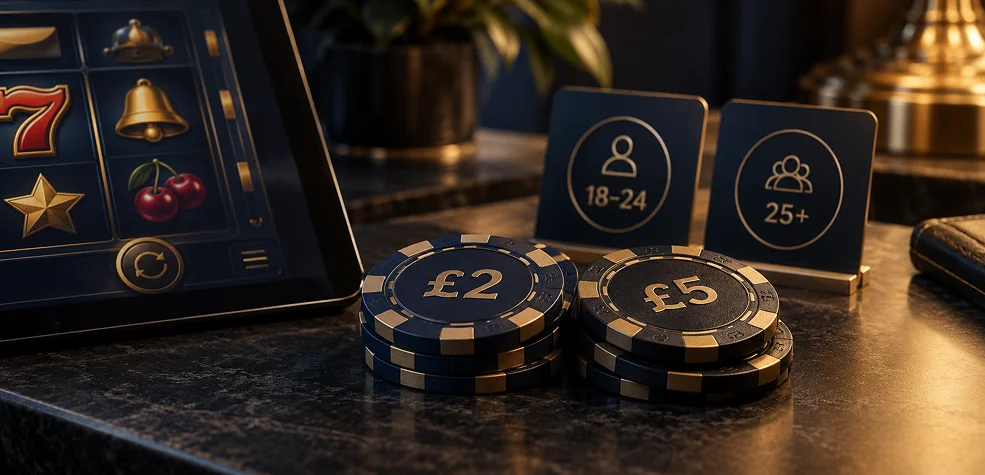
The rule is narrow. In UKGC's wording an online slot is a reel-based casino game played over the internet, and the cap covers only that product. Saying that the maximum bet at UK online casinos is £5 would be wrong. The correct reading is that the £5 maximum applies to online slot game cycles for customers aged 25 and over. Roulette, blackjack and other casino games fall outside this stake rule.
What Counts as a Game Cycle?
A game cycle starts when the player initiates a game. It ends when the stake has been lost or when any winnings are made available to collect. So £5 is a cap per complete cycle, not per single reel movement. One UKGC example involves a 27-year-old who puts in £2: the game may still offer up to £3 more inside that cycle, reaching £5 in total.
Why UK Online Slots Cannot Run Faster Than 2.5 Seconds
The relevant provision is 14D in the Commission's technical standards for remote gambling. A slot must leave 2.5 seconds between the start of one game and the earliest start of the next cycle. The player must also release and press the start control again, so holding a button down does not start a new cycle.
The rule limits when the next cycle may start, not how long an animation lasts. A game may show its result sooner than 2.5 seconds after the spin begins, but it cannot accept the next stake until the interval has passed.
The Stakelogic Case in 2026
The rule is enforced. On 25 June 2026 UKGC announced that Stakelogic BV would pay £122,835 under a regulatory settlement. Its game Tiger Temple 88 allowed a gap of only 1.97 seconds between spins and was out of line from 28 to 30 May 2025.
Re-testing the company's whole British catalogue turned up 15 further games that fell short, by margins from 0.001 to 0.675 seconds. UKGC noted that the supplier had checked compliance with a hand-held stopwatch. The Commission links fast game cycles to increased risk for consumers. Stakelogic supplies games to other operators' websites and apps, as many game providers do, so one error reaches several brands.
Why Autoplay Is Not Available
Requirement 8A in the same set of standards obliges the system to make a customer commit to every game cycle separately. UKGC states the aim as making clear that auto-play cannot be offered for online gaming.
That wording matters. The rule covers online gaming as a category, so describing it as a ban that exists only for UK online slots would be inaccurate. Each spin needs its own action, which fits the wider responsible gambling framework as a product requirement.
Turbo, Quick Spin and Spin-Stop Features
Requirement 14E bars a system from letting a customer shorten the time before a result is shown. UKGC guidance lists turbo, quick spin and slam stop as features that are not permitted for casino games. Exceptions include scratch-all or reveal-all features and bonus games where no additional stake is wagered.
Skipping a visual element that serves no purpose after the outcome is settled does not allow the next slot cycle to begin earlier than the 2.5-second interval. The two rules work together.
Can Players Run Several Slots at the Same Time?
No, not through functionality that the casino provides. Requirement 14C states that the gambling system must not offer functionality which facilitates playing multiple games at the same time. Split-screen and multi-screen features are the examples UKGC gives.
The ban reaches casino games in general, not only slots: UKGC updated the wording in January 2026 so that it refers to games instead of slot games. It concerns what the operator's interface offers, not how many tabs or devices a person uses.
Other UK Game Design Rules Players May Notice
Losses disguised as wins. Requirement 14F says the system must not celebrate a return that is less than or equal to the total stake. If a player stakes £2 and the game returns £1.50, it must not use win-style sounds or visuals. Showing the amount awarded or a short sound indicating the transfer to the balance is acceptable.
Time on screen. For casino sessions, requirement 13C says elapsed time must be displayed for the duration of the gaming session, which is why a UK slot may show a running clock.
Do the £2 and £5 Limits Apply to Every Online Casino Game?
No. The cap belongs to online slots alone. Other products fall under different UKGC requirements, and some differ: casino games apart from slots and peer-to-peer poker have a 5-second minimum game cycle.
| Product | £2/£5 slot stake rule |
|---|---|
| Online slots | Yes |
| Roulette | No |
| Blackjack | No |
| Live casino | No, unless the specific product falls within the legal online-slot definition |
| Sports betting | No |
Why the Same Slot Can Look Different Outside Great Britain
Providers and operators can supply different configured versions of one game for different regulated markets, so the same title elsewhere may differ in speed-related features, autoplay or stake settings. Nothing in the UKGC material suggests the return to player changes between versions, so this page makes no claim about it. For how that figure works, see our guide to RTP and volatility.
Do UK Slot Rules Apply to Offshore Casinos?
UKGC requirements apply to gambling software and services provided to consumers in Great Britain under a Gambling Commission licence. A site without that licence is outside this framework, so none of the protections described here can be assumed there. Checking which casino licenses an operator holds shows which rules it must follow.
Conclusion
British slot rules go well beyond the £2 and £5 stake limits. A player also meets a 2.5-second gap between cycles, no autoplay, no turbo or slam stop, no multi-game screens and restrictions on how small returns are presented.


















 Germany