DE
DE
 ES
ES
 PT
PT





RTP and Volatility in Casino Games: What Players Should Know
Behind every slot or table game are two numbers that most players never look at closely: RTP and volatility. Neither one tells you what's coming in your next round. What they do tell you is how the game was built — how the math behind it distributes wins over time, what game risk level it carries, and how bumpy or smooth that distribution feels while you play. This article walks through both concepts in plain terms and flags where players commonly get the wrong idea about what these numbers can actually do.
What RTP Means in Casino Games
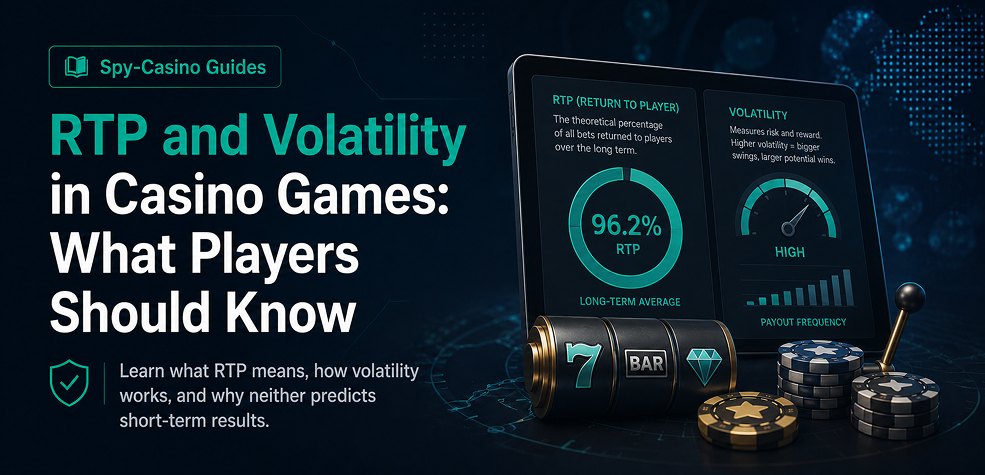
RTP stands for Return to Player. Think of it as a blueprint number, not a live score — it's worked out by running a game through millions upon millions of simulated rounds and measuring what share of the total money staked eventually flows back to players.
A game listed at 96% RTP was built so that, across that enormous simulated dataset, 96 cents out of every dollar wagered eventually returns as winnings, and 4 cents stays with the operator as margin. That's the whole idea — a mathematical blueprint, fixed at the design stage, checked and signed off by testing labs before the game ever goes live. It doesn't move depending on your luck. It doesn't climb the longer you sit at a machine. It has zero connection to how much you personally have put in today.
Why RTP Does Not Predict Short-Term Results
Worth stating plainly: that percentage has nothing to say about your next handful of spins, your afternoon at the tables, or even a run of several sessions stacked together.
Picture that 96% spread across a dataset so massive that a single player, playing every day for years, still wouldn't scratch the surface of it. Zoom into any one sitting, and outcomes bounce around wildly — sometimes landing far under what the number implies, sometimes soaring past it. Both are perfectly ordinary. Neither breaks anything.
There's no internal counter tracking your losses that eventually triggers a payout, no mechanism that makes a machine "catch up" after a dry spell. Each spin fires independently, with no memory of what came before. The belief that a game is "overdue" simply doesn't survive contact with how the randomness actually works — however convincing it feels in the moment. This exact misreading trips up plenty of people browsing online slots and other titles across the board.
What Slot Volatility Means
Where RTP sketches the eventual destination, volatility describes the terrain along the way.
It's a measure of how a game distributes its risk — the rhythm of how often it pays, and the rough scale of those payouts when they show up. A cousin concept, hit frequency, narrows in on one piece of that: simply, what proportion of rounds return anything at all, small or large.
Some titles are engineered to drip out modest wins constantly. Others stay silent for long stretches before delivering something sizeable. Together, these two ideas shape what a session actually feels like to play — a dimension entirely separate from whatever the RTP figure claims about the distant average.
Low, Medium and High Volatility Games
Developers tend to sort titles into three loose tiers, although the exact cutoffs aren't standardized across the industry.
Low-volatility slots hand out wins on a fairly regular basis, though typically in modest sizes. Your bankroll drifts up and down in small steps rather than swinging wildly. That doesn't translate into "lower risk" in any real sense — the same house margin is baked in regardless — it just reshapes the tempo at which that margin plays out.
Medium-volatility games land somewhere in the middle: a fairly even mix of moderate wins arriving at a moderate pace, without leaning hard into either extreme.
High-volatility slots go quiet more often, but the payouts, when they finally arrive, can dwarf the stake by comparison. A session here might crawl along with nothing for a long while, then jump unexpectedly. None of these three categories is inherently "better" for winning — they're simply different textures wrapped around the same underlying edge. That holds whether you're tapping through mobile casinos, sitting in on live dealer games, or scrolling through a standard slot library.
RTP vs Volatility: The Key Difference
Two distinct questions get confused constantly. RTP answers: over an almost incomprehensibly large number of rounds, what fraction of stakes is this game engineered to give back? Volatility answers something else entirely: what does the journey there actually look like — a steady trickle, or occasional bursts?
Two games can carry identical RTP figures and still play completely differently, because volatility governs the pacing of a session while RTP governs an average that virtually no one will ever personally witness in full. Neither figure can forecast a specific spin, hand, or evening — both describe engineering choices, not outcomes.
How Players Can Use RTP Information
In practical terms, these numbers are good for exactly one job: knowing what you're stepping into before you play, not forecasting what will happen once you do. A published RTP figure, paired with a volatility rating where one exists, gives you a rough sketch of the pattern ahead — steady small activity, or longer lulls punctuated by bigger spikes.
It functions a bit like reading a product label before a purchase — it shapes expectations, not results. Scanning a casino comparison or browsing casino games sorted by RTP is a reasonable way to get your bearings. None of it bends the math of any specific session in your favor, and treating it that way misses the point entirely.
Common Mistakes When Choosing Casino Games
A few misconceptions keep resurfacing around this topic:
- Believing high RTP slots mean a win is coming soon. It's a figure drawn from millions of rounds — not a tally that resets per session.
- Equating low volatility slots with lower overall risk. They reshape the payout rhythm; the house margin underneath stays exactly the same.
- Fixating on the RTP number alone. Two titles sharing an RTP can deliver wildly different experiences once volatility enters the picture.
- Waiting on a machine because "it hasn't hit yet." Rounds don't remember each other — nothing about the past shifts the odds ahead.
- Assuming one published RTP applies universally. Some games run different RTP configurations depending on the platform or operator hosting them, so it's worth confirming the figure matches the exact version in front of you.
Spy-Casino Game Selection Checklist
Before committing real money to a title, run through this:
- Confirm the published RTP applies to the specific version you're about to play.
- Look for a volatility rating, if the developer provides one.
- Decide whether the payout rhythm on offer — frequent and small, or rare and large — matches what you actually want from a session.
- Keep in mind RTP reflects a distant average, not a short-term forecast.
- Set your own time and spending limits before the session starts, not partway through.
- Check whether the game risk level matches the type of session you're comfortable with.
RTP and volatility describe how a game was engineered — not what's going to happen to you personally. Neither is a strategy, and neither should be treated as one. Set a time and spending limit before you start, and if stopping becomes difficult, deposit limits, self-exclusion tools, and local responsible gambling services are available.
FAQ
What does RTP actually mean in a casino game?
It's a percentage — Return to Player — describing what share of wagered money a game is engineered to return across an enormous number of simulated rounds. It says nothing about any one session.
Will a higher RTP get me better results?
It points to a smaller built-in margin over an enormous stretch of play, but it has no bearing on what a single session looks like, which can swing widely no matter what the published figure says.
How does volatility differ from RTP?
RTP is the distant average return. Volatility is the shape that return takes on the way there — steady and small, or occasional and large. They're answering different questions entirely.
Is a low-volatility slot the safer choice?
Not in any overall sense. It pays more frequently in smaller chunks, but the same underlying house margin applies regardless of which volatility tier you're playing.
Can RTP signal that a game is about to pay out?
No. It's an average stretched across millions of independent rounds. Whatever happened in previous spins has zero influence on the next one.
Why do two slots with matching RTP feel so different?
Volatility, not RTP, sets the pacing of a session. Identical long-run averages can sit underneath completely different payout rhythms.
Where would I actually find a game's RTP and volatility rating?
Typically inside the game's info panel or paytable. Some developers also list a volatility rating there, worth checking regardless of whether you're on mobile casinos, inside live dealer games, or elsewhere.














 Germany