DE
DE
 ES
ES
 PT
PT


No-KYC Casinos in 2026: What "No Verification" Really Means
A casino can let you register with only an email, take a crypto deposit, and have you spinning within minutes. Then, right before your first withdrawal, it asks for a passport.

That's not the casino backtracking on a promise. Most "no KYC" claims are simply narrower than they sound. The label usually describes what happens at one stage of an account's life, not a blanket guarantee that documents will never come up. This guide breaks down what "no KYC" actually covers, where the exceptions sit, and what to check before you deposit anywhere claiming to skip verification.
What Does "No KYC Casino" Actually Mean?
Treating it as a single yes-or-no label is where most confusion starts. Verification isn't one gate. It's a series of them, and a casino can be "no KYC" at some and not others.
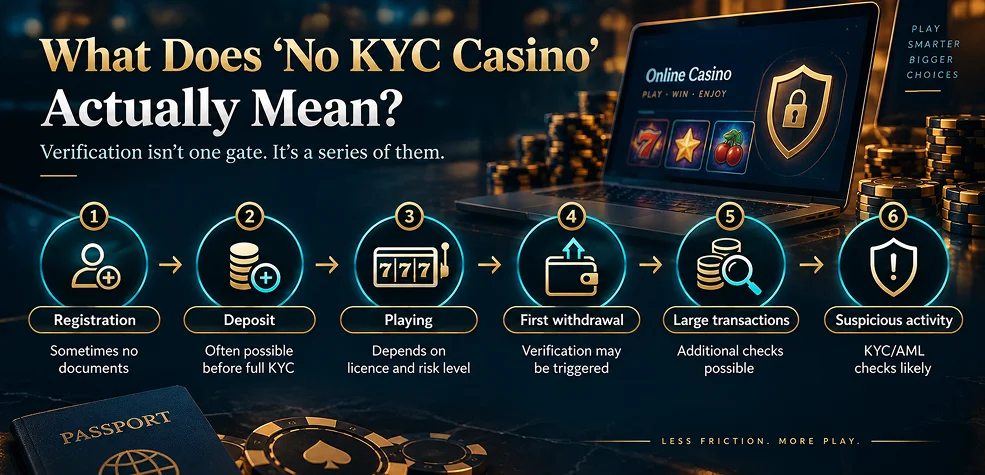
| Stage | Verification May Be Required? |
|---|---|
| Registration | Sometimes no documents |
| Deposit | Often possible before full KYC |
| Playing | Depends on licence and risk level |
| First withdrawal | Verification may be triggered |
| Large transactions | Additional checks possible |
| Suspicious activity | KYC/AML checks likely |
Read down that table and a pattern emerges: verification tends to arrive later the further you go, not earlier. A casino advertising "no KYC" is almost always describing the top rows, not a promise that covers the whole table.
Four Different Things Casinos Call "No KYC"
No Documents at Registration
The lightest version. Sign up with an email, a password, a date of birth. No passport upload is required just to create the account.
Delayed KYC
You can start playing right away, but the operator asks for documents further down the line, often once specific conditions are met.
Risk-Based Verification
Two players at the same casino can have completely different experiences. One deposits, plays, and withdraws without ever uploading an ID. Another gets flagged almost immediately because of the amount involved, an unusual payment pattern, or account activity that reads as inconsistent.
Full KYC Before Gambling
Some regulated markets don't allow any of the above. The UK Gambling Commission's own licence condition is explicit on this: operators "must obtain and verify information in order to establish the identity of a customer before that customer is permitted to gamble," including name, address, and date of birth. In a market like that, "no KYC" simply isn't an available business model.
Which brings up the point worth repeating throughout this article: comparing "no KYC" across casinos without accounting for licence and jurisdiction tells you very little.
Why a No-KYC Casino Can Still Ask for Documents
None of these triggers is universal. A casino weighing risk might flag one and ignore another, and thresholds vary by operator. But these are the situations where a "no KYC" casino most commonly asks for verification anyway.
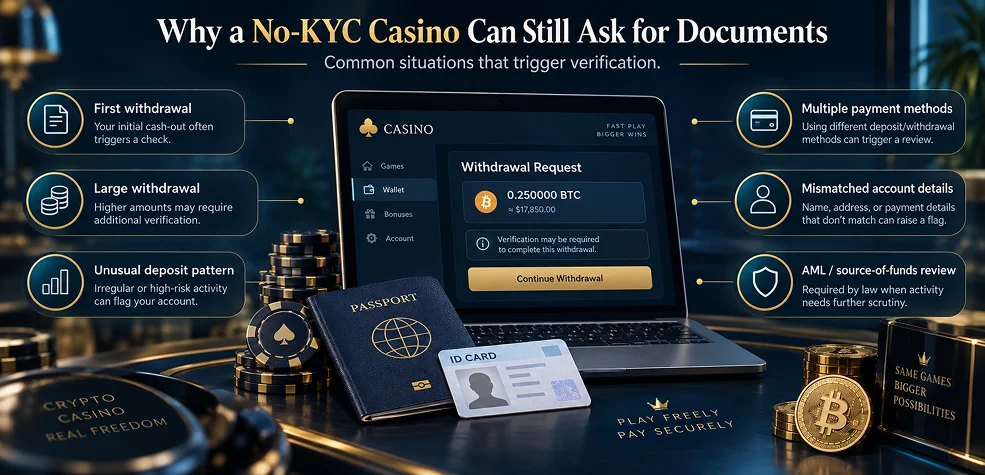
- A first withdrawal request
- A particularly large withdrawal
- Deposit activity that looks unusual for the account
- Several different payment methods used on one account
- Payment details that don't match the account holder's information
- Signs pointing to multiple accounts from one person
- Documents that appear altered or inconsistent
- An investigation into possible bonus abuse
- A source-of-funds review
- Broader AML obligations the operator has to satisfy
FATF's own September 2026 guidance on gaming and gambling names several of these directly as red flags: multiple accounts and payment methods tied to different identities, mismatches between customer information and payment data, and suspicious or fraudulent identity documents all appear on its list of indicators tied to money laundering risk in the sector.
Curaçao Casinos and KYC in 2026
Worth being direct about this, especially given how often Curaçao licensing gets framed as loose: the CGA's current system is not the same thing as "licensed no-KYC casinos."
Under the LOK, licensees are required to maintain policies covering customer identification and verification, AML and counter-terrorist-financing measures, account and fund management, and responsible gambling. The approach is risk-based, meaning the depth of a check scales with how risky a given customer or transaction looks, rather than every player facing an identical process. But identity verification stays part of the system regardless, and it isn't something a Curaçao licence lets an operator skip. Industry compliance sources put standard due diligence thresholds in the range of roughly EUR 2,000–2,500 in transaction value, above which verification requirements typically apply, with enhanced checks for higher-risk indicators like PEP status or crypto payments.
The takeaway matters more than any specific number: a Curaçao casino license should never be read as proof that a casino stays permanently free of KYC.
Is a Crypto Casino Automatically Anonymous?
No, and this is worth separating from the broader crypto-and-casinos conversation already covered elsewhere.
A crypto wallet isn't the same thing as a verified bank account, that much is true. But blockchain transactions can be public, and a casino still typically knows your email, IP address, device, and account history regardless of what payment rail you used. Operators can and do run KYC on crypto users, and wallet or payment ownership can get checked just like a card or bank transfer would.
Crypto changes how money moves. It doesn't remove identity or AML requirements by itself. For a deeper look at how crypto payments and privacy interact at online casinos, see our full crypto casinos guide.
KYC vs Source of Funds: Two Different Checks
These get lumped together constantly, but they're answering different questions.
KYC asks who you are. That's typically a passport or ID document, a date of birth, an address, and sometimes a selfie for a liveness check.
Source of funds asks where the money came from. That can mean bank statements, payslips, transaction records, or evidence from an asset sale. It's a heavier ask, and not one every casino makes for every player.
Not every operator runs both on every account. UK regulators still classify the remote casino sector as carrying elevated money-laundering risk, which is part of why some operators layer financial checks on top of standard identity verification rather than treating KYC as the finish line.
Why KYC Often Appears at Withdrawal
Players notice verification most at the exact moment they're trying to get paid, which is why it feels like a bait-and-switch even when it isn't one.
Three things get lumped together here that shouldn't be: a verification trigger planned in advance, a legitimate AML or risk check responding to something specific, and a bad practice where a casino only asks for documents after a win despite having every chance to ask sooner. UK regulators take a clear line on that last case, prohibiting operators from using a withdrawal request as an excuse to demand information they could reasonably have collected earlier.
If a withdrawal is taking longer than expected because of a document request, it is also worth checking the casino's withdrawal rules and comparing them with fast withdrawal casinos.
No KYC Does Not Mean No Rules
A casino skipping upfront verification isn't automatically anonymous, unlicensed, or illegal. It doesn't mean instant withdrawals, no age checks, no AML controls, no account restrictions, no source-of-funds reviews, or that the operator only deals in crypto.
The reverse holds too. A casino that does run full KYC isn't automatically safer or better run than one that doesn't. Verification is one input, not the whole picture. Actual safety depends on the licence behind the operator, how the casino handles withdrawals and complaints, its payment rules, and whether it offers real responsible gambling tools.
5 Casinos With Low-Upfront Verification Reviewed by Spy-Casino
Here's how five online casinos with lighter upfront checks actually handle verification, based on what their own policies and reviews say:
| Casino | KYC at Sign-Up | When Documents May Be Requested | License |
|---|---|---|---|
| CHEXX Casino | Email and password only | At cash-out, past a threshold, or if a risk flag is raised | Curaçao |
| Beef Casino | Email confirmation | Before first withdrawal | Curaçao (OGL/2024/169/0146) |
| AllStarz Casino | No documents required to register | Full KYC if requested, typically ID and proof of address | Kahnawake Gaming Commission |
| SpinBetter Casino | Sign-up via email or social/wallet login | KYC may be requested before withdrawal | Anjouan (ALSI-202607036-FI2) |
| Tycoon Casino | Personal and payment details, no ID upload | ID required past a threshold; proof of funds for large or high-risk accounts | Anjouan |
Two notes before this goes live. SpinBetter and Tycoon Casino both operate under Anjouan licensing, and player reviews for that jurisdiction report inconsistent enforcement, so treat the licence line as informational rather than a guarantee of recourse. The review links above also need confirming against the actual published URLs, and every entry needs a fresh check against its current terms and licence status, not just what an earlier review said.
How to Check KYC Rules Before You Deposit
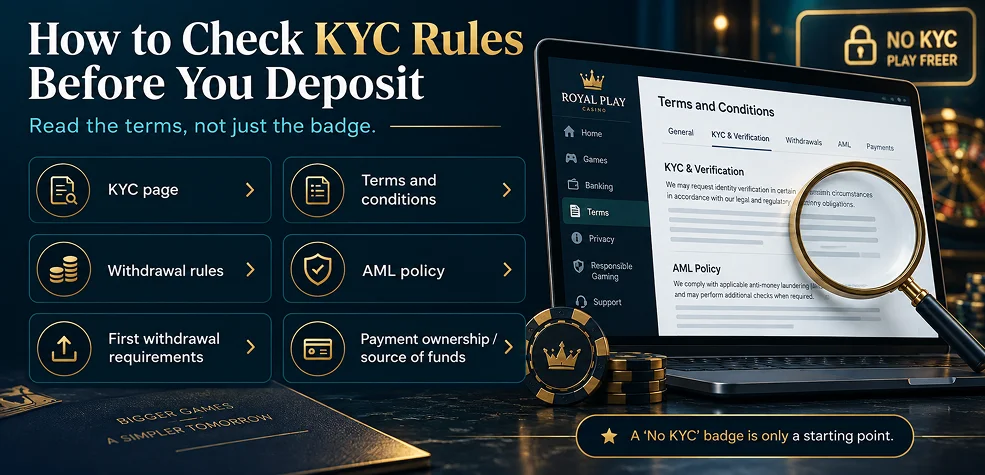
Before you deposit anywhere, run through this short list:
- Look for a dedicated verification or KYC page.
- Read the terms and conditions, not just the promotional copy.
- Check the withdrawal terms specifically.
- Look for an AML policy or reference to one.
- Confirm the casino's licence and who issued it.
- Find out whether the first withdrawal requires documents.
- Check whether payment ownership needs to be confirmed.
- See whether large transactions trigger additional checks.
- Note whether source-of-funds checks get mentioned anywhere.
Don't stop at a homepage badge that says "No KYC." That badge describes a starting point, not the whole relationship you're about to have with the casino.
Red Flags in "No Verification" Casino Claims
A few signs suggest a casino's no-KYC marketing deserves more scrutiny, not less: claims of being "100% anonymous" with no explanation of how that squares with payment processing; a "never KYC" promise sitting next to terms that include a verification clause; no visible KYC policy anywhere on the site; no clear disclosure of the operator or licence behind the brand; terms granting unlimited rights to request documents without saying why; promotional pages that contradict the terms themselves; or verification that only appears after a large win, with no conditions published in advance that would have explained it.
Conclusion
In 2026, "no KYC" is better read as a description of when verification happens rather than a promise that it never will. Verification status alone doesn't tell you whether a casino is trustworthy either. That depends just as much on its casino license, its payout terms, and its responsible gambling tools. The useful question isn't "Does this casino have KYC?" It's "What verification is required, at which stage, and under what conditions?" Ask that instead, and no-KYC casinos worth using start to look a lot more predictable than their marketing suggests.

















 Germany