DE
DE
 ES
ES
 PT
PT
-
 SpinBetter Casino
Reviews
SpinBetter Casino
Reviews
-
 Slotoro Casino
Reviews
Slotoro Casino
Reviews
-
 Lucky Lion Casino
Reviews
Lucky Lion Casino
Reviews
-
 HitnSpin Casino
Reviews
HitnSpin Casino
Reviews
-
 V.Vegas Casino
Reviews
V.Vegas Casino
Reviews
-
 Blockspins Casino
Reviews
Blockspins Casino
Reviews
-
 FieryPlay Casino
Reviews
FieryPlay Casino
Reviews
-
 SpinEmpire Casino
Reviews
SpinEmpire Casino
Reviews
-
 Coins Game Casino
Reviews
Coins Game Casino
Reviews
-
 Hollywin Casino
Reviews
Hollywin Casino
Reviews
-
 GlitchSpin Casino
Reviews
GlitchSpin Casino
Reviews
-
 Bet25 Casino
Reviews
Bet25 Casino
Reviews
-
 DailySpins Casino
Reviews
DailySpins Casino
Reviews
-
 FortuneJack Casino
Reviews
FortuneJack Casino
Reviews
-
 Aerobet Casino
Reviews
Aerobet Casino
Reviews
-
 Horus Casino
Reviews
Horus Casino
Reviews
-
 Vegaz Casino
Reviews
Vegaz Casino
Reviews
-
200% up to €1500 + 150 FS Get

-
Up to €500 + 150 FS Get

-
325% up to $2000 Get

-
390% up to €1500 + 150 FS Get

-
Up to €300 + 30 FS Get

-
625% up to €2500 + 350 FS Get

-
325% up to $2500 + 125 FS Get

-
345% up to €800 + 250FS Get

-
275% up to €500 + 80 FS + 25 BC Get

-
220% up to €2200 + 80 FS Get

-
600% up to $8000 Get

-
100% up to $/€1000 or 1 BTC + 200 FS Get

-
500% up to 5000 FS Get

-
125% up to €1000 + 40 FS Get

-
100% up to €200 + 25 FS Get

-
250% up to €1000 + 150 FS Get

-
100% up to €1000 + 200 FS Get

Gambling Deposit Limits in Europe: UK, Germany and Spain Compared
Two players can see the same phrase — “deposit limit” — and face completely different rules. A player in Great Britain can use a limit set for their own gambling account, while in Germany deposits made with different licensed operators can count toward the same monthly allowance. Spain currently uses fixed daily, weekly and monthly ceilings, with a broader shared system scheduled for 2027.
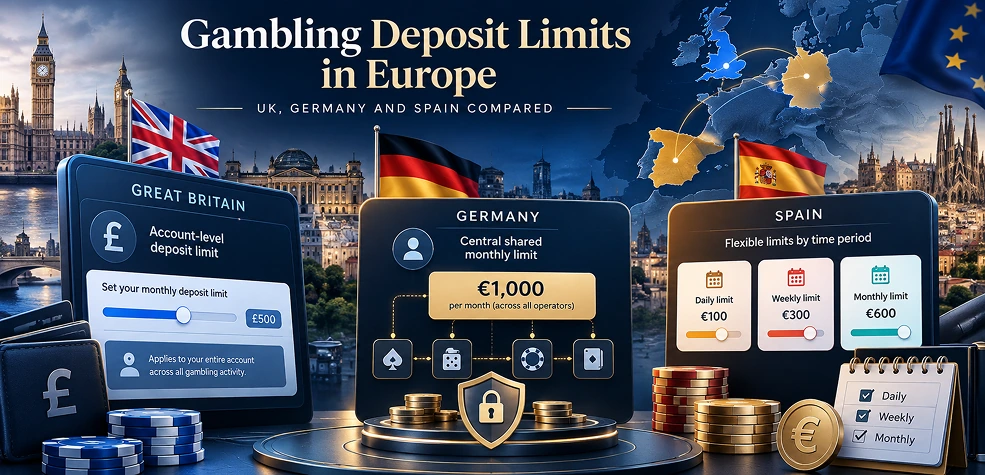
That difference exists because Europe has no single rulebook for online gambling. EU countries remain responsible for organizing their own gambling markets, so online gambling deposit limits depend heavily on where the player is located.
Online gambling deposit limits in Europe at a glance
| Country | How the System Works | Main Rule in 2026 | Shared Across Operators? |
|---|---|---|---|
| Great Britain | Player-accessible gross deposit limits | No single national £ cap | No |
| Germany | Monthly shared limit | Normally up to €1,000 per calendar month | Yes |
| Spain | Fixed daily, weekly and monthly ceilings | €600 / €1,500 / €3,000 | From March 2027 |
The important point is not which country has the “highest” limit. The three systems are designed differently, so comparing the headline numbers alone can be misleading.
Why Europe does not have one deposit limit
There is no EU-wide law telling every online casino how much a player may deposit. The European Commission states that gambling services are not covered by sector-specific EU legislation. National governments can therefore choose their own regulatory models as long as those systems comply with wider EU law. That produces several approaches at once: one regulator may concentrate on tools players configure themselves, another may create a legal maximum, while a third may count activity across multiple licensed websites. Our guide to online gambling regulation in Europe looks at the wider regulatory differences.
Great Britain: a limit the player can set
Great Britain does not use one national rule saying every online gambler may deposit no more than £X each month.
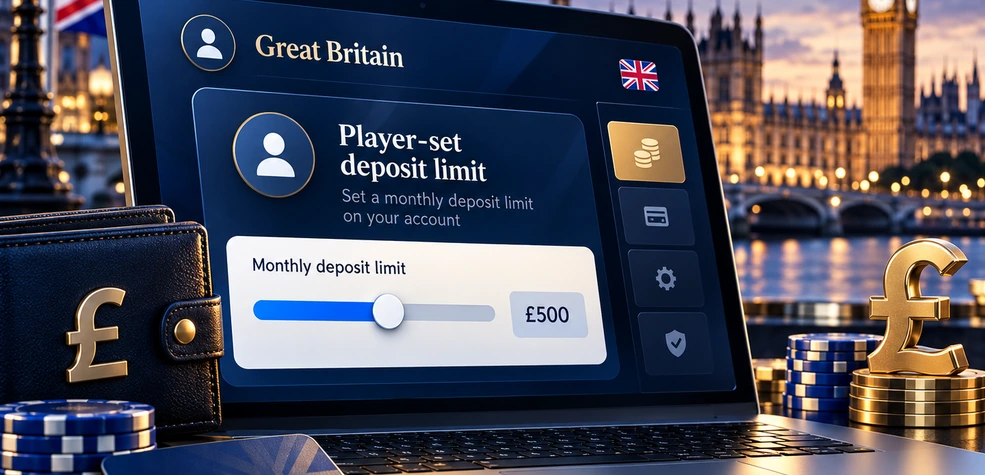
Instead, UK-licensed remote operators must provide customers with gross deposit limits. The current requirements took effect on September 30, 2026, after the Gambling Commission moved implementation from the original June deadline. Operators must make gross limits available, describe them as “deposit limits,” and give them at least the same prominence as other financial-limit tools. The required gross limits use fixed periods, allowing customers to control deposits over defined windows rather than relying on a vague spending setting.
Gross deposit limit: a simple example
“Gross” refers to money going into the gambling account. Imagine a player deposits £400 and later withdraws £150. For the purpose of a gross deposit limit, the relevant deposited amount remains £400. The £150 withdrawal does not reduce it. That is different from a net-based tool, where withdrawals can be offset against deposits. UK operators may provide other financial controls as well, but the plain term deposit limit is reserved for the gross version.
This distinction also explains why deposit and withdrawal rules should not be mixed together. Our separate guide to casino withdrawal limits covers payout caps and cashout rules. For British players, there is no single nationwide monthly maximum.
Germany: one monthly allowance can follow the player
Germany takes a much more centralized approach.

For gambling products covered by the system, the standard cross-operator deposit limit is no more than €1,000 per calendar month. The amount is counted across participating licensed operators rather than reset every time the player opens another account. For example, depositing €700 with one covered operator can leave only €300 of a €1,000 monthly allowance for another. This is why the German rule is fundamentally different from an account-level limit.
What LUGAS does
The rule is enforced through LUGAS, Germany’s cross-state gambling supervision system. One part of LUGAS is the central limit file, which allows participating operators to determine whether a player’s applicable cross-operator allowance is still available. Once that amount has been used, additional deposits are technically prevented. Players do not have to manually transfer their deposit history from one operator to another because the system handles the relevant check.
Is €1,000 always the final maximum?
Not necessarily. Players normally choose an individual cross-operator amount up to €1,000. Some authorized operators can apply different limits under the German regulatory framework, so the standard amount should not be interpreted as an absolute ceiling in every individual case. What matters for this comparison is the architecture: Germany uses a shared monthly mechanism, rather than treating every licensed gambling account as a completely separate deposit pot.
Spain: fixed limits today, shared limits next year
Spain currently takes another route.
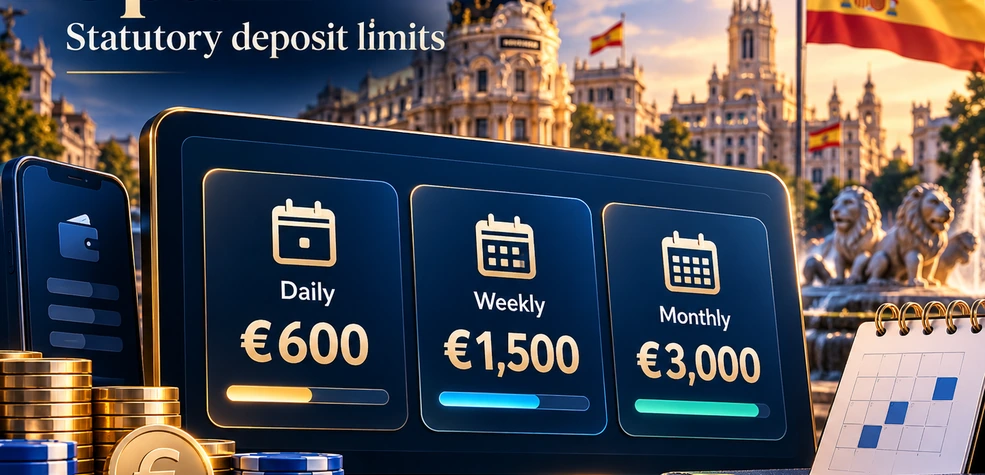
Instead of starting with a cross-operator monthly allowance, the regulated market uses specific deposit ceilings:
- €600 per day
- €1,500 per week
- €3,000 per month
Players can choose lower personal amounts if they want tighter control. The existing model operates at operator level, which matters because Spain has already approved the next stage of its system.
A cross-operator layer arrives in March 2027
Royal Decree 520/2026, dated June 24, 2026, establishes joint deposit limits that will be considered across online gambling operators. The new amounts are:
- €700 per day
- €1,750 per week
- €3,300 per four-week period
However, these are not the limits Spanish players are already using in October 2026. According to the Spanish gambling regulator DGOJ, the joint system becomes applicable on March 25, 2027, with an operator integration and testing period before launch. Spain therefore changed the legal framework in 2026, but the player-facing cross-operator mechanism belongs to 2027.
One phrase, three regulatory designs
Put the three markets side by side and the difference becomes clearer. Great Britain emphasizes a financial-control tool available to the individual customer, with no universal national amount shared by every player. Germany uses a central monthly framework that can follow the same player between participating licensed operators. Spain currently combines statutory account-level limits with a transition toward shared cross-operator controls. All three can be described using the words “deposit limit,” but they are not variations of exactly the same system.
Personal, regulatory and cross-operator limits
Another useful distinction is who actually controls the number.
| Type | In Practice |
|---|---|
| Personal limit | A player selects an amount for their own gambling activity |
| Regulatory limit | Rules set a mandatory framework or ceiling |
| Cross-operator limit | Deposits are considered across multiple licensed operators |
More than one layer can exist at the same time. A player may voluntarily choose an amount below what regulation would otherwise permit, while an operator cannot use a player’s higher preference to bypass a mandatory regulatory restriction. Personal financial limits are therefore one part of a broader responsible gambling framework rather than a substitute for national rules.
Deposit, stake and loss limits are different tools
These terms are easy to mix up because all three involve money. A deposit limit deals with funds added to a gambling account, a stake limit deals with how much can be wagered, and a loss limit is concerned with losses over the period defined by the relevant tool or regulatory system. Germany illustrates the distinction particularly well: deposit, stake and loss limits are treated as separate player-protection tools, while additional statutory restrictions may apply to particular gambling products. Reaching one limit therefore does not automatically tell you what another limit allows.
What to check before making a deposit
Before relying on a number shown in a cashier or account menu, check:
- which licence applies to your account;
- whether the limit is voluntary or required by regulation;
- whether activity at other operators is included;
- what time period the limit uses;
- whether withdrawals affect the calculation;
- what happens if you request a higher amount;
- whether a waiting period applies;
- whether your payment method imposes a separate transaction maximum.
That last point is easy to overlook. A bank, card, wallet or payment service can have its own transaction rules even when the gambling regulator would permit a larger deposit.
Why your country matters more than the casino logo
The same casino brand can serve different markets under different regulatory conditions. A customer accessing the British version may see UK financial-limit tools, a German account may be subject to the LUGAS framework, and a Spanish player faces the limits established for Spain. So a global payment page or generic casino FAQ cannot always tell you which online gambling deposit limits apply to your own account. Start with the jurisdiction. Our casino licenses section explains how different regulatory systems work, while the online casinos directory provides information on individual operators.
Conclusion
There is no European number that functions as a universal gambling deposit cap. Great Britain, Germany and Spain illustrate three different approaches: player-accessible gross limits, a centralized cross-operator monthly system, and statutory caps that are moving toward shared controls in 2027. Before making a deposit, identify the system behind the account first. The amount matters, but who sets it, what period it covers and whether it follows you between operators matter just as much.
Sources: European Commission; UK Gambling Commission; Gemeinsame Glücksspielbehörde der Länder (GGL); Dirección General de Ordenación del Juego (DGOJ).

















 Germany