DE
 ES
 PT


Can a Casino Change Its Terms After You Have Already Deposited?
Picture the sequence: you sign up, pay in under one set of conditions, and a few weeks on the casino posts updated terms. Something new now limits what you can do, and it was not there on the day you deposited.
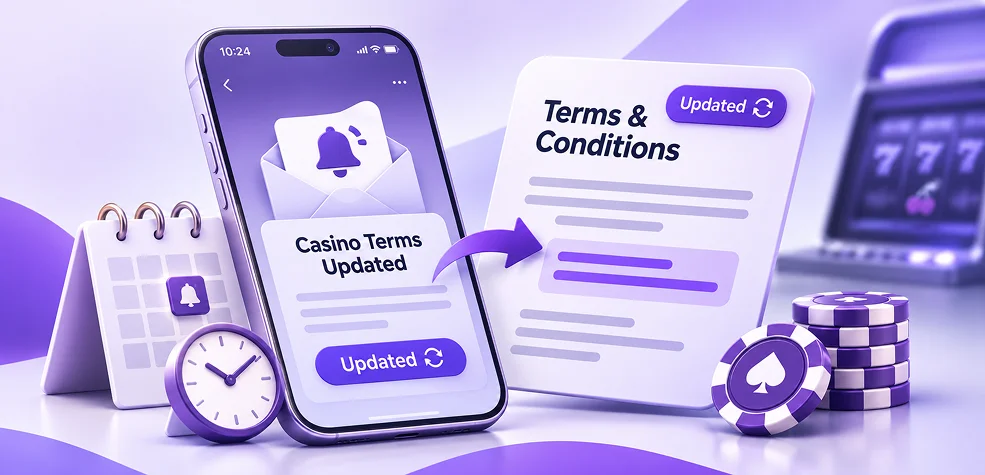
Whether an operator may ever amend its contract is the easy part of the question. What matters more is how an amendment reaches a person who is already a customer. Great Britain serves as the regulatory example here, and the text offers general information, not legal advice.
Can an Online Casino Change Its Terms?
Yes, terms can change, but a regulated operator is not given a free hand to rewrite them.
In Great Britain, the Commission's licence condition 7.1.1 is the starting point for operators holding one of its operating licences. Among other things, it asks for:
- terms that are not unfair under the Consumer Rights Act 2015;
- terms and consumer notices that are transparent under the same Act;
- contract terms available in an easily accessible way;
- notice of material changes before they take effect.
Since 6 April 2026, the same condition also requires licensees to avoid unfair commercial practices within the meaning of the Digital Markets, Competition and Consumers Act 2024. Saying an operator can never revise its terms once you have registered would be wrong. Saying it can do whatever it likes would be just as wrong.
What Is a Material Change?
The wording of 7.1.1 does not define "material change" and sets no minimum notice period. In practical terms, a change that significantly affects a customer's rights, obligations or use of the service is more likely to be material than a purely editorial amendment. The rows below are illustrations, not reports of real casino terms:
| Type of change | Illustrative example | What it can affect |
|---|---|---|
| Fees | A new charge on withdrawals | The amount the customer receives |
| Withdrawal conditions | A higher minimum withdrawal | When and how money can be taken out |
| Account restrictions | New limits on using the account | What the customer can do after the change |
| Eligibility | A new requirement to use an offer | Whether the customer still qualifies |
| Dispute procedure | A different route for complaints | How a problem can be raised and resolved |
| Treatment of customer funds | A new rule on releasing balances | Money already in the account |
Rewording alone is not necessarily material. The test is the effect on the customer.
Does the Casino Have to Tell You Before New Terms Apply?
In Great Britain, for material changes, yes: customers must receive notice before the changes take effect. It might arrive as an email, an account message or a website notice.
Condition 7.1.1 does not prescribe a specific notification channel or a minimum notice period. It does, however, require customers to be notified before a material change takes effect, while the contract itself must remain transparent and easily accessible.
If no notice ever reached you, look in your spam folder and in the inbox inside your account before drawing conclusions.
Can New Terms Affect Money Already in Your Account?
It depends. No rule says an old balance always stays under old terms, and none says new terms automatically apply to everything. Six factors shape the answer:
| Factor | What to look at |
|---|---|
| Nature of the change | Fees, withdrawals or restrictions, or only wording |
| Contract wording | What the clause says about existing balances |
| Jurisdiction | Which regulator and consumer rules apply |
| Fairness | Whether the change tilts the contract against the customer |
| Retrospective effect | Whether it reaches money deposited earlier |
| Treatment of player funds | How balances are held and released |
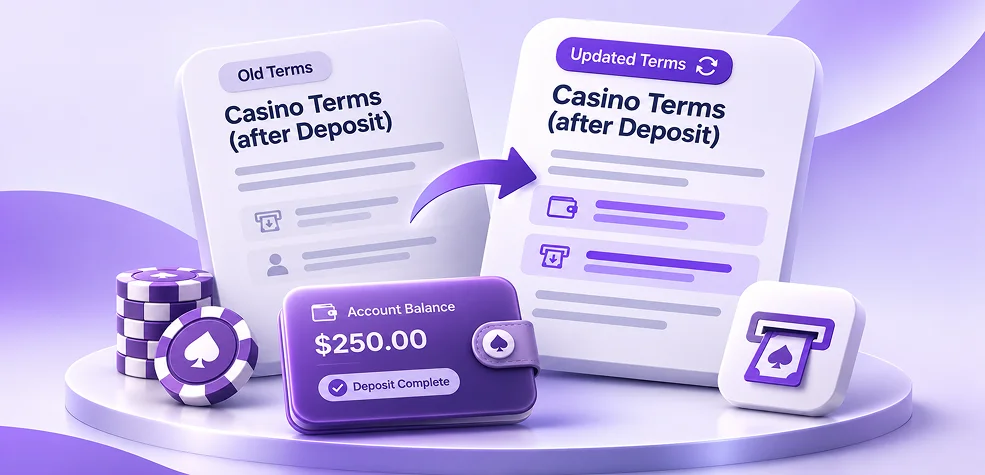
Under the Consumer Rights Act fairness test referenced by the Commission, a term may be unfair if it causes a significant imbalance in the parties' rights and obligations to the detriment of the consumer. If a change affects money already held in the account, its application would still need to satisfy the same fairness and transparency requirements. The outcome cannot be assumed simply because the funds were deposited before the change.
Can Withdrawal Rules Change After You Deposit?
They can be revised like other terms, yet withdrawal conditions are among the changes most likely to count as material. The minimum withdrawal, the payout method, fees or other restrictions could all be touched, and each affects what a customer can do with their own money.
In February 2022 the Commission reported finding licensees with potentially unfair terms, among them terms that allow them to confiscate customers' unstaked deposits. How long a payout takes is a separate subject, covered in why online casino withdrawals get delayed.
The issue remains current. In a regulatory action published on 21 October 2026, the Commission found that L & L Europe Limited had used an unfair withdrawal term that allowed only one withdrawal request at a time; it also recorded withdrawals being withheld for reasons other than regulatory or legal requirements.
Can Bonus Terms Change After You Have Already Opted In?
Offers get stricter treatment than the general contract. The Commission's guidance says operators must not rely on terms that let them alter or withdraw a promotion once a customer has signed up, deposited or begun playing, except where that is needed to stop fraud or comparable unlawful conduct.
The same guidance adds that terms must not be changed after a player has opted to take part. How to read an offer in the first place is covered in how to read casino bonus terms before you claim an offer.
Is "We Can Change These Terms at Any Time" Enough?
No. A sweeping variation clause does not cancel the duty to be fair and transparent. Under the condition, any change has to meet the same fairness and transparency requirements, and customers must be told about material changes before they come into effect.
As an example of what not to do, the Commission's promotions guidance cites a clause reserving sole discretion to amend and modify the terms at all times. Its wider guidance also advises against terms that leave it to the operator alone to decide whether and how a clause is applied.
What Should You Save When the Terms Change?
Keep a record before anything disappears from the site. The table shows what to save and why it helps:
| What to save | What it shows |
|---|---|
| Old and new terms | The wording as it stood before and after the update |
| Effective date and notification | The date it took effect and how you were informed |
| Screenshots | Dated copies of pages that may change |
| Deposit date and account balance | Your deposit and the money affected |
| Withdrawal status | Any payout request still open at the time |
| Bonus opt-in date, if relevant | When you accepted a promotion |
A dated screenshot is useful because the live page displays just the latest wording.
What If the Change Looks Unfair?
Take these steps in sequence:
- compare the old and new wording;
- establish the effective date;
- save the evidence;
- contact the operator;
- use the complaint procedure where appropriate.
Begin with the operator: quote the clause, give the date you spotted the change and say what outcome you expect. If that fails, the Commission has noted that consumers can take a complaint to an independent dispute-resolution provider, which has to apply consumer protection law, including a fairness test for contract terms.
Do the Same Rules Apply in Every Country?
No. Great Britain is one regulatory example. Other jurisdictions run their own contract and consumer protection regimes, so notice, fairness and retrospective effect may be answered differently.
The licence behind a casino shows which regulator's rules to look at, and the wider picture is in online gambling regulation in Europe: what changed in 2026.
Conclusion
A casino can update its terms, but a regulated operator gains no free hand to rewrite player rights after the fact. In Great Britain, changes must stay fair and transparent, material ones need notice before they take effect, and a promotion a customer has already opted into should not be altered. Whether a change reaches money already in your account depends on its nature, the contract wording and the jurisdiction, so keep dated copies of the terms and your balance.


















 Germany